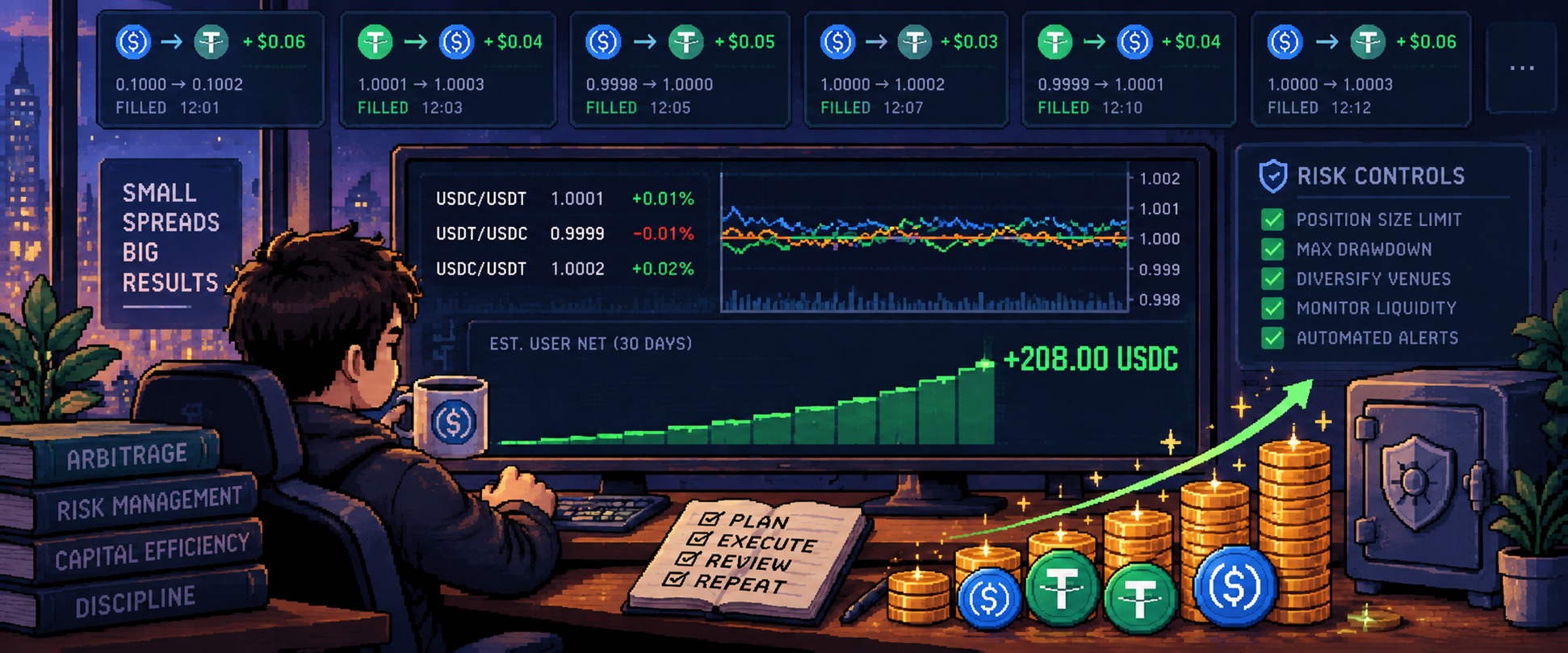
Small spreads, repeated with discipline
One basis point is 0.01%. On a trade of roughly USD 2,500, that is about 25 cents. It is easy to dismiss an opportunity that small. It is also why the execution matters: fees, available depth, partial fills and the final sell all decide whether a quoted spread becomes a realized gain.
Noman's early user #3 configured a 2,500 USDT cap per cycle. The bot buys USDT with USD through a post-only limit order, then places a limit sell for the filled USDT against USDC. Actual fills may be smaller than the cap. The cycle is counted as traded only after both legs are completed and reconciled.
What the 30-day ledger shows
| Filled cycles | 2,072 |
|---|---|
| Positive / negative cycles | 2,070 / 2 |
| Filled cycles below 1 bp | 87.4% |
| Median realized spread | 0.40 bp |
| Cumulative buy-leg notional | USD 4,999,814.09 |
| Trading PnL after recorded trading fees | 277.34 USDC |
| Estimated platform fee, 25% of cumulative PnL | 69.33 USDC |
| Estimated user net profit | 208.00 USDC |
The ledger also contains 1,636 completed cycles with no buy fill and zero trading PnL. They are excluded from the filled-cycle counts and spread distribution above. Buy-leg notional counts each completed cycle once; it does not add the sell leg a second time.
Why the small numbers add up
The median filled cycle earned about 0.40 bp, and 87.4% earned less than 1 bp. The result came from repeated execution, not a single large spread. Over the observation window, the account recorded almost USD 5 million in cumulative buy-leg notional while keeping each cycle within its configured size cap.
For a simple scale comparison, 208.00 USDC is 8.32% of the 2,500 USDT cycle cap over 30 days. The cap is a trading limit, not a measurement of the account's full capital, so this ratio is not an account return or APY.
Risk controls are part of the record
There were two losing filled cycles. This is live trading, and a stablecoin pair does not make a trade risk-free. Noman checks current order-book depth and fees before opening a cycle, limits the amount that can be called into each cycle, and reconciles outstanding orders before starting another one when execution is uncertain. Liquidity, partial fills, stablecoin prices and exchange availability can still affect outcomes.
This is one early account over one 30-day window. It shows that sub-1-bp spreads can accumulate into a meaningful realized result under this setup. It does not say the same frequency or profit will repeat. We will keep measuring completed trades, costs and losses as the product matures.